UPCOMING WORKSHOPS FOR INDIVIDUAL AUTHORS | INSTITUTIONAL WORKSHOPS | PAST WORKSHOP REPLAYS
The easiest way to know about our upcoming cohorts, workshops, and courses is to sign up for our email newsletter, where we regularly announce our events.
Our current courses and cohorts (both free and paid) are also available on our Teachable site.
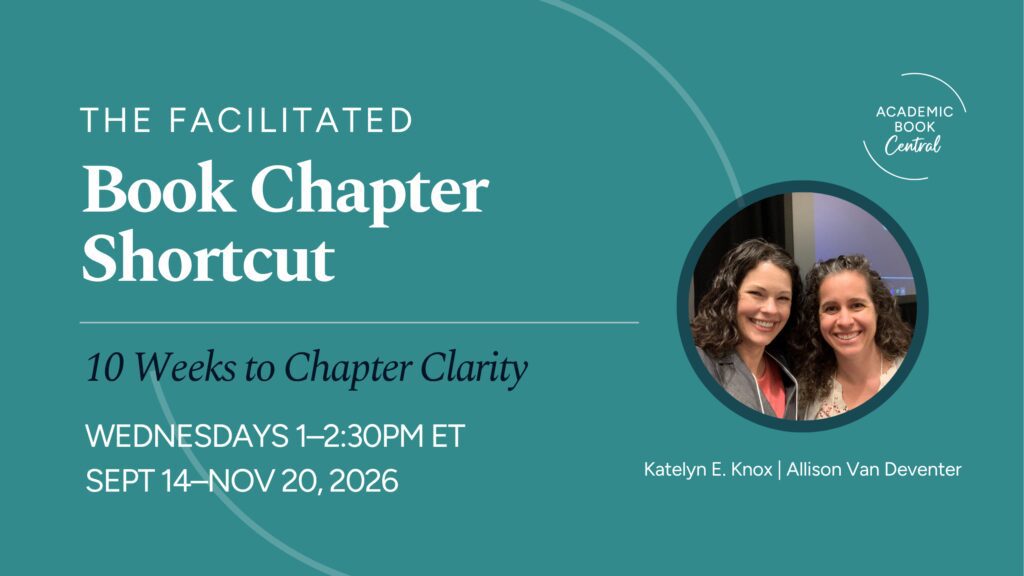
10-Week Book Chapter Shortcut Cohort: Wednesdays 1-2:30 pm ET Sept. 14-Nov. 20, 2026
Are you ready to get your chapter into shape?
In this facilitated 10-week Book Chapter Shortcut, which runs from September 14 to November 20, you’ll work alongside a cohort of authors to revise a messy draft into a solid, argument-driven book chapter. Through practical, manageable prompts, you’ll learn how to plan structural revisions and implement them. And along the way, you’ll develop writing and revision strategies that fit into your life—doable within your schedule, adapted to your writing habits, and responsive to your source material.
The core of the course will be our weekly 90-minute Zoom meetings, which will be held on Wednesdays from 1 to 2:30pm Eastern. We’ll also hold an optional coworking session/office hour on Fridays from 2 to 3pm Eastern. And we’ll have a discussion board and a library of video clips, plus we’ll post recordings of the meetings, so you can easily catch up if you have to miss a session.
This course is designed for authors who have existing writing (notes, a dissertation chapter, conference papers, seminar papers) and need to revise that writing into a monograph chapter. It is NOT designed for authors who merely have an idea for a chapter but have not yet written any material.
We can’t guarantee that you’ll have a finished draft by the end of the course, since a lot depends on how much time you have to spend on it outside of our weekly meetings. But we’ll work in a way that will allow you to tackle the biggest issues first, and save the smaller ones for later—so even after the course is finished, you’ll be able to keep working with the tools you’ve acquired. And because you’ll have permanent access to the materials after the course is done, you can go back at any time and catch up or review.
Never Miss a Workshop!
Sign up for our email list, where we announce upcoming cohorts.
The Dissertation-to-Book Workshop
In this Zoom workshop, we cover:
- How a book is really different from a dissertation
- Steps you can take to finally get a handle on your “book argument”
- How to develop your “book voice” and eliminate dissertationese
Book Questions, Chapter Answers
In this Zoom workshop, we cover:
- How to distill your book’s main claims and thread them throughout your chapters
- How your book’s organizing principle shapes its argument
- How to get a sense of your book’s narrative arc
Invite us for an Institutional or Conference Workshop
We are available to give workshops for faculty members about the book-writing process via Zoom or in person. Below, you will find a list of topics we are able to cover. Institutional workshops typically include one or two topics, but we are happy to tailor something to your specific needs and interests.
To inquire about setting up a workshop for your group, contact us at [email protected]m.
Pinpointing & Sharpening Your Book Argument
What makes for a strong, significant book argument? How does it differ from a topic statement or a collection of chapter arguments? You know your book needs a strong central argument to get published. But book arguments are complex and have a lot of points to hit: they’re tied to your book’s structure and need to emerge from your evidence. Where to start? In this workshop, we discuss the anatomy of a strong, significant book argument and show, using examples, how it differs from a claim for significance, a topic statement, and a collection of chapter arguments. We then walk you through some practical exercises for pinpointing your argument and testing its alignment with your book’s evidence. You’ll leave with language you can use to pitch your book to publishers, craft a standout book proposal, and write your book and chapter introductions.
Eliminating Dissertation-ese: Tips for Writers of First Books
How can you make your book sound less like a dissertation? In this workshop, Allison offers practical advice for authors making the transition from dissertation to book manuscript, with an emphasis on where, how much, and how to cite other scholars’ work. Based on Allison’s experience as a developmental editor, she’ll explain why, although the work of revising the substance of the manuscript can be onerous, finding your “book voice” is often much more straightforward than many first-time authors imagine. The strategies you learn in this workshop will help you write and cite with confidence, even beyond your book.
Assembling and Revising Your Book Chapters Efficiently
Do you have some material for your book chapters (dissertation chapters, seminar papers, or even just research notes) but dread the actual act of “writing your chapter” or “revising” what you have into a solid first draft? How do you know what to cut and what to keep? Will this pile of notes ever turn into something publishers will accept? And, if so, how long will it actually take? The answer: much, much less time than you fear! In this workshop, we present the process of “assembling” a book chapter—a method that will allow you to generate a very rough but workable chapter draft in hours, not weeks or months. We then introduce revising principles you can use to transform this rough draft into your final chapter. The best part? These strategies work for journal articles, too! By taking this one workshop, you can save hundreds of hours across your academic career.
Find Your Narrative Arc: Strategies for Assessing Your Chapters
You may have heard advice to develop and emphasize your book’s “narrative arc.” What does that mean in practice? In this workshop, we walk through a series of playful exercises designed to help you reflect on what each chapter contributes to your book and how the chapters build on each other to tell a story. At the end of the workshop, we discuss ways to handle outlier chapters and background information. You will leave with a clearer understanding of how each chapter functions within the book and language to describe your narrative arc to editors, mentors, and peers.
Book Proposal Workshop
In this workshop, Allison breaks down the common elements of a book proposal and explains how to approach each one. Drawing on her experience as the editor of numerous successful book proposals, she demystifies the genre of the proposal and gives practical tips for writing the various sections. During the Q&A, she will answer questions about approaching editors, assembling the other components of the proposal package, and submitting the proposal. You will leave with a fuller understanding of book proposals in general, greater confidence about writing your own, and the option to set up an appointment with Allison to review your proposal draft in detail.
Q&A with Katelyn and Allison
In this open-ended workshop, Katelyn and Allison answer questions from faculty members about any aspect of writing and publishing a book: getting started, planning out the book, threading the argument through the book, establishing a sustainable writing process, working with an editor, writing a book proposal, contacting presses, and so on. We’ll be glad to tailor this session to the needs of the participants in any way you’d like.
Facilitated Dissertation-to-Book Workbook Experience
In this facilitated workshop, which meets once a week for 6 weeks, we guide participants through Phase I of the Dissertation-to-Book Workbook. The workshop is designed for book authors who want practical steps, expert guidance, and peer support as they dive into the work of drafting a book manuscript. To benefit from the workshop, authors should have some of their ideas (substantial parts of at least 50% of their chapters) down on paper already in the form of dissertation chapters, notes, conference papers, journal articles, and so on. Via conversations and hands-on exercises, participants will evaluate their book’s scope and organizing principle, draft answerable research questions, produce chapter snapshots, describe their narrative arc, assemble an argument, identify what to cut and what to keep, and much more. This workshop requires participants to spend about 6 hours per week on writing exercises at their own pace outside the scheduled workshop time.
